How many of you know that in 1999, a "metric mishap" caused NASA to lose a 125 million dollar Mars orbiter? It's true! One team used the Metric System to record their data and measurements, while another team used the Imperial System (the system we use in America). It's stupid that such a simple mistake was allowed to happen and cost us 125 million dollars. If only we weren't so stubborn, and would just convert to the Metric System, mistakes like this wouldn't happen.
However, since I don't see that happening in the near future, it'd probably be a good idea to learn how to convert our units into the Metric System! (Just in case you ever find yourself working on a Mars orbiter!) We'll start with length which is quite easier. You simply need to know that 1 inch is equal to 2.54 centimeters. This should allow you to be able to switch between the two, although it might be a pain converting up or down to inches and centimeters. An easy conversion factor for volume is 1 milliliter equals .61 inches cubed. An nice one to remember for mass is 1 kilogram is equal to 2.2 pounds. These are just a few of the many conversions you may need, visit this conversion calculator to get the hang of the conversion factors.
If you're interested in how different measurement systems got their start, check out the video below!
Showing posts with label Conversion. Show all posts
Showing posts with label Conversion. Show all posts
Friday, April 23, 2010

Monday, April 19, 2010
In Defense of the Metric System
Do you know how many gills are in a cup? What about how many teaspoons are in a tablespoon? Didn't know the answer to either one of those questions? Don't worry, neither did I, and I'm sure we're not alone. Thanks to the unnecessarily complicated American System of Measurement (also known as the Imperial System), you may be expected to know many trivial measurements such as these, but without any logical way to remember them. That's why I believe we should switch to the metric system, also known as the SI. (International System of Units, abbreviated SI from the French le Système international d'unités)
The SI uses a standard conversation method across all units of measurement, making it extremely easy to remember how to convert units. After learning the three base units (meter for length, liter for volume, gram for mass) you simply need to apply the proper prefix and add or subtract a few zeros! See the chart below for the prefixes associated with the SI.
See, isn't that so much easier to work with? As you may have noticed, the entire system is based upon simple multiples of 10! I don't see how anyone could argue it's easier to remember 12 inches in a foot-3 feet in a yard-1760 yards in a mile, and let's not even get into converting the other way, that is breaking the inch into 16ths!
The SI uses a standard conversation method across all units of measurement, making it extremely easy to remember how to convert units. After learning the three base units (meter for length, liter for volume, gram for mass) you simply need to apply the proper prefix and add or subtract a few zeros! See the chart below for the prefixes associated with the SI.
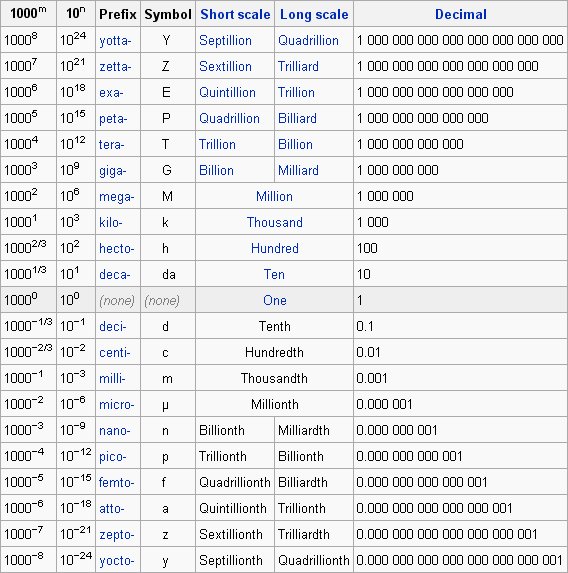
See, isn't that so much easier to work with? As you may have noticed, the entire system is based upon simple multiples of 10! I don't see how anyone could argue it's easier to remember 12 inches in a foot-3 feet in a yard-1760 yards in a mile, and let's not even get into converting the other way, that is breaking the inch into 16ths!
Subscribe to:
Posts (Atom)


